Why Your Roofing Website Isn't Ranking (And It's Probably Not What You Think)
Ajay Seth
Founder
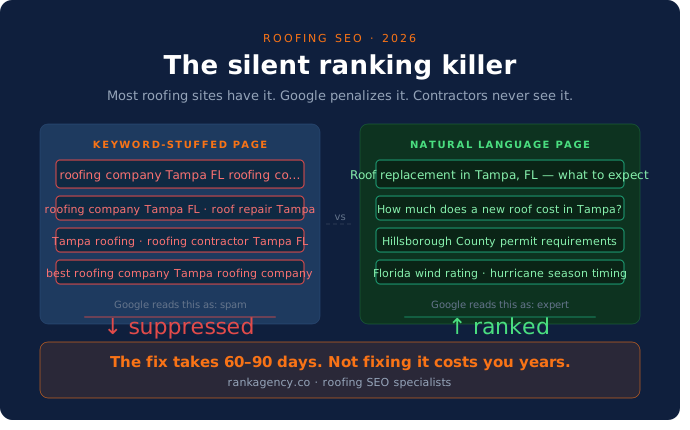
Keyword stuffing is the number one silent killer of roofing websites in 2026. It doesn't trigger a warning in Google Search Console. It doesn't look broken to the contractor who built it. It just quietly prevents the site from ranking — sometimes for years — while the contractor spends money on ads wondering why organic never works.
This post covers exactly what keyword stuffing looks like on roofing sites, why Google penalizes it even when it looks normal, and the specific fixes that move rankings within 60–90 days of implementation.
What keyword stuffing actually looks like on roofing websites
Most roofing contractors think keyword stuffing means filling a page with the same phrase 100 times in red text. That's 2005 keyword stuffing. Google caught up with that a long time ago.
In 2026, keyword stuffing on roofing sites looks like this:
A homepage that says “roofing company” in the headline, the subheadline, the first paragraph, the services section header, the about section, the footer, and the meta title. Each instance looks natural in isolation. Together they create an unnatural keyword density that Google's language models flag as optimized for a search engine, not written for a human.
A service page for “roof repair Tampa FL” that mentions “roof repair Tampa FL” in the H1, the first sentence, the second paragraph, the image alt text, the CTA button, and the meta description — all within 300 words of content. The page exists to rank for a keyword, not to help a homeowner understand what roof repair involves, what it costs, or how long it takes.
A city page for Houston that was built by taking the Tampa city page and replacing every instance of “Tampa” with “Houston.” Google reads both pages, recognizes the identical structure and near-identical content, and either ranks neither or ranks the one with more authority — which is usually a competitor who built the page properly.
These are not edge cases. Across every roofing site we audit, keyword stuffing in one of these forms appears on the majority of pages.
Why Google suppresses keyword-stuffed roofing sites
Google's core ranking systems evaluate whether content was created primarily for search engines or primarily for users. A roofing service page that mentions “roof replacement Houston TX” eight times in 400 words fails this test — not because of the keyword count, but because a page optimized for a human reader would naturally use variations: “roof replacement,” “replacing your roof,” “new roof installation,” “how long roof replacement takes in Houston.” The absence of natural language variation is itself a signal.
The 2025 Helpful Content system, now baked into Google's core ranking algorithm, evaluates this at a site-wide level. One keyword-stuffed page affects how Google evaluates every page on your domain. A roofing contractor with 10 thin, keyword-stuffed city pages is suppressing their homepage, their service pages, and their blog posts — all of them — because Google's confidence in the entire domain drops.
This is why contractors who invest in new blog content and better backlinks sometimes see no ranking movement: the keyword stuffing elsewhere on the site is depressing the domain's overall quality signal. You can't build on a foundation that Google has already discounted.
The 4 most common keyword stuffing patterns on roofing sites
Pattern 1 — Footer keyword blocks
A block of text at the bottom of every page listing every service and city: “Roof repair Tampa, roof replacement Tampa, roofing contractor Tampa, emergency roofer Tampa, roofing company Tampa FL…” This was a common tactic in 2015. Google has been penalizing it since 2018. It still appears on the majority of roofing sites we audit.
Pattern 2 — Templated city pages
The same 400-word page duplicated across 20 cities with the city name swapped. Google identifies these as near-duplicate content and either ignores them or actively suppresses them. A roofing contractor targeting Tampa, Houston, Dallas, Jacksonville, Las Vegas, and New York needs six genuinely different pages — different content, different local context, different conversion angles. Not one template with a find-and-replace.
Pattern 3 — Keyword-dense title tags across every page
“Roofing Company Tampa FL | Best Roofing Contractor Tampa | Roof Repair Tampa FL | Smith Roofing” — a title tag trying to rank for four different keyword variations at once. Google reads this as keyword stuffing. A clean title tag — “Roof Replacement Tampa FL | Smith Roofing” — outperforms it because it signals relevance for one clear query.
Pattern 4 — Alt text keyword stuffing
Every image on the site has alt text reading “roofing company Tampa FL” regardless of what the image actually shows. Alt text exists to describe images for accessibility and to provide context to Google's image crawlers. Stuffing keywords into every image alt text triggers the same quality penalty as text-based stuffing.
What to do instead — the fix that actually moves rankings
The fix is not removing keywords. The fix is replacing thin, keyword-dense content with genuinely useful content that happens to include keywords naturally.
A service page for roof replacement in Tampa should answer the questions a Tampa homeowner actually has: How much does roof replacement cost in Tampa? How long does it take? What materials work best in Florida's climate? How does the insurance claim process work for storm damage in Tampa? Do I need a permit in Hillsborough County?
A page that answers these questions in 1,200–1,500 words will naturally include “roof replacement Tampa” multiple times — but it will also include “Hillsborough County permit,” “Florida wind rating requirements,” “hurricane season timing,” and dozens of other natural language variations that tell Google this page was written for Tampa homeowners, not for a keyword ranking. That signal is what moves rankings.
The same principle applies to city pages. Our Tampa roofing SEO page covers storm market dynamics, insurance claim keyword strategy, and the specific competitive landscape in that city — because that's what makes a Tampa page useful to a Tampa contractor. Our Houston roofing SEO page covers completely different content because Houston is a completely different market. Templating between them would make both pages worse.
How long does it take to recover from keyword stuffing
Fixing keyword stuffing on a roofing site typically produces first ranking movement within 60–90 days on secondary keywords, and primary keyword improvement within 4–6 months. The timeline depends on how extensive the stuffing is and how long it has been in place.
The fastest results come from fixing the highest-traffic pages first — homepage, primary service pages, and top city pages. Fixing footer keyword blocks site-wide also produces fast movement because it removes a site-wide quality suppressor in one action.
The slowest recoveries happen when contractors fix one or two pages but leave keyword-stuffed city pages, footer blocks, or alt text stuffing in place. Google evaluates the domain holistically. Partial fixes produce partial results.
The checklist: does your roofing site have a keyword stuffing problem?
Run through these five checks on your site right now:
- 1. Count how many times your homepage says "roofing company" or "roofing contractor." If it appears more than 4 times in the visible content, you likely have a density problem.
- 2. Look at your footer. Does it contain a paragraph or list of services and cities? That's a keyword block — remove it or replace it with a proper sitemap-style footer with navigation links only.
- 3. Open your top city pages side by side. If they share more than 50% of their content with only the city name changed, they are templated pages that Google is likely suppressing.
- 4. Check your image alt text. Open your browser's developer tools, inspect your homepage images, and read the alt text. If every image says "roofing company [city]," you have alt text stuffing.
- 5. Read your service pages out loud. If they sound like they were written to include a keyword rather than to help a homeowner make a decision, rewrite them. Google's language models are sophisticated enough to detect the difference between content written for users and content written for rankings — and so will your prospects.
What a clean roofing site looks like to Google
A roofing site that Google rewards in 2026 has service pages that read like they were written by someone who has actually replaced hundreds of roofs and knows what questions homeowners ask. It has city pages with genuine local context — permit requirements, climate considerations, storm history, competitive landscape. It has a blog that builds authority by answering the real questions homeowners search for before they hire a roofer.
None of that requires avoiding keywords. It requires using keywords the way a knowledgeable roofer would use them naturally in conversation — not the way someone trying to rank a page would force them into every available space.
The roofing contractors ranking on page 1 in competitive markets like Houston and Tampa are not there because they stuffed more keywords than their competitors. They're there because Google has more confidence in their domains — and that confidence comes from content that consistently demonstrates real knowledge of the roofing industry, not just familiarity with roofing keywords.
Before spending another dollar on ads or backlinks, run your site through the five checks above. If keyword stuffing is present, fixing it is the highest-leverage action available — and it costs nothing except the time to rewrite the pages properly.
Get a free roofing SEO audit
We'll identify every keyword stuffing issue on your site alongside the 50+ other technical and local factors we check — before you pay anything.
Get my free audit